
Vinegar and bleach both show up in kitchen cleaning routines, but they don't do the same job, and reaching for the wrong one can waste effort or damage a surface. Vinegar is a mild acid that works well on everyday grime, water spots, and light odor, while bleach is a disinfectant meant for killing bacteria and viruses on hard, non-porous surfaces. This guide is part of Kitchen Cleaning Questions & Troubleshooting, and it breaks down exactly when to use vinegar, when bleach makes more sense, and which surfaces should never see either one.
Quick Answer: Vinegar or Bleach?
Use vinegar for routine cleaning, cutting through grease film, deodorizing, and general wiping of countertops, appliance exteriors, and glass. Use bleach when you need to disinfect a surface after handling raw meat, poultry, or eggs, or when dealing with mold or mildew on a sealed, hard surface. Vinegar is not a registered disinfectant, so it won't reliably kill harmful bacteria the way bleach can. Bleach, meanwhile, is too harsh for everyday use on most kitchen surfaces and should never be combined with vinegar or other acids.
What Vinegar Does Well in the Kitchen
White distilled vinegar is a mild acid, typically around 5% acetic acid in household form. That acidity is what makes it useful for breaking down mineral buildup, light grease, and soap scum on non-porous surfaces.
Vinegar works well for:
- Wiping down laminate or sealed countertops for everyday grime
- Cutting through grease residue on stovetop surfaces (once cooled)
- Removing water spots and mineral film from stainless steel sinks and faucets
- Deodorizing the inside of a microwave or refrigerator
- Cleaning glass cabinet fronts or glass stovetops without leaving streaks
Vinegar is not a disinfectant in the way bleach is. It may reduce some surface bacteria to a degree, but it isn't registered or tested to the same standard as EPA-registered disinfectants, so it shouldn't be relied on after handling raw meat or eggs. It's also acidic, which means it should be avoided on natural stone countertops like marble, granite, or limestone, since the acid can etch and dull the surface over time. Unsealed wood cutting boards and butcher block can also be affected by regular vinegar use, since the acid may dry out the wood or affect certain finishes.
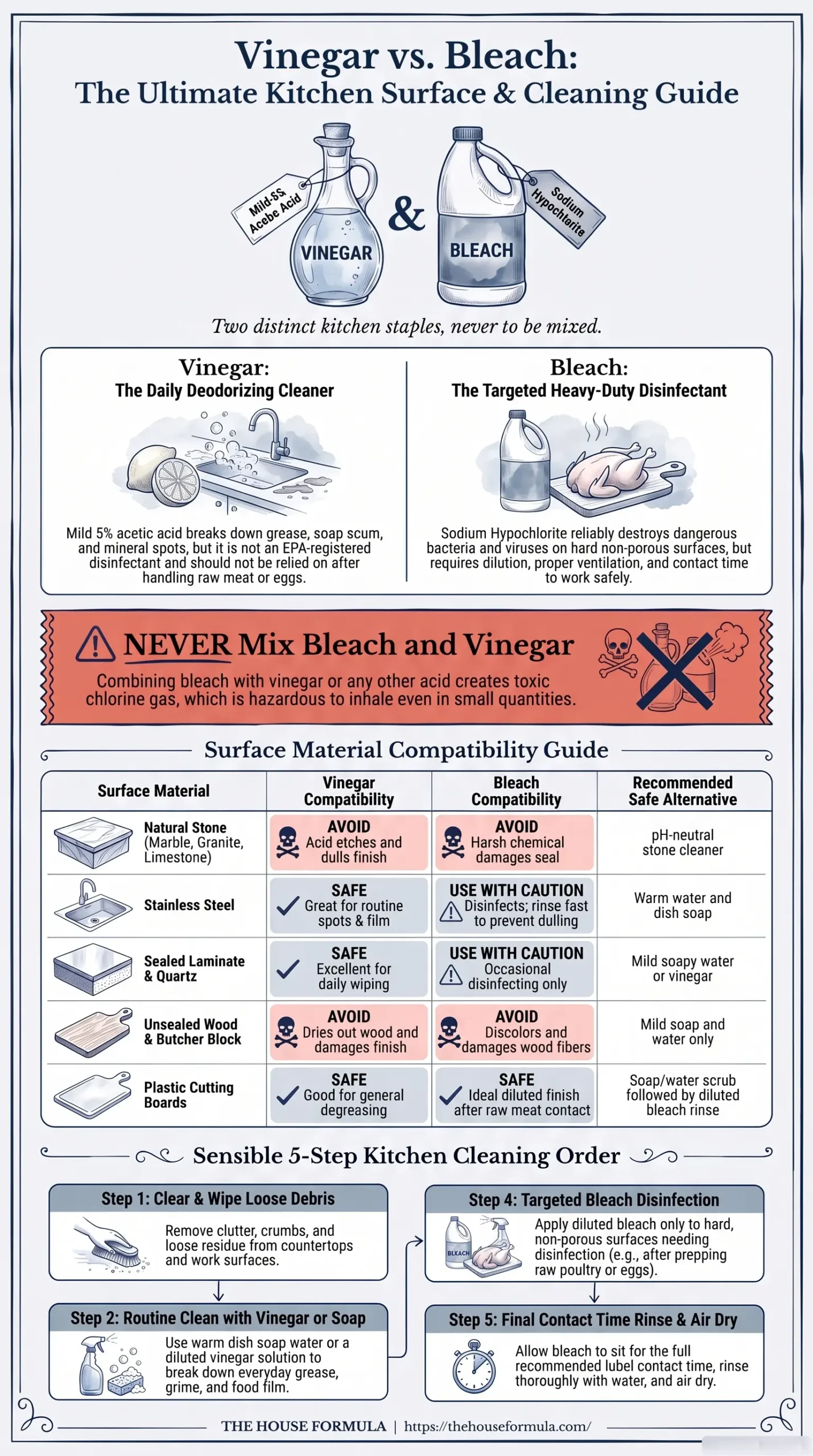
Photo Credit: Hobby Guidebook Editorial
What Bleach Does Well in the Kitchen
Household bleach (sodium hypochlorite) is a strong disinfectant, meaning it's formulated to kill a broad range of bacteria and viruses when used according to label directions. This makes it useful in specific, targeted situations rather than as a daily all-purpose cleaner.
Bleach works well for:
- Disinfecting a cutting board or countertop after contact with raw poultry, meat, or eggs
- Treating visible mold or mildew on sealed, hard, non-porous surfaces
- Sanitizing a sink basin periodically, particularly stainless steel
- Whitening certain plastic or ceramic surfaces where discoloration has built up
Bleach should always be diluted according to the product label before use, since full-strength bleach is more corrosive and can damage surfaces or irritate skin and lungs. It's also not suitable for every material. Natural stone, unsealed wood, and many colored plastics can be damaged or discolored by bleach, and it should never be used on aluminum cookware or trim, since it can cause pitting and discoloration. Always check the product label and, where possible, the surface manufacturer's care instructions before applying bleach to anything beyond a plain, sealed, hard surface.
Vinegar vs Bleach: Side-by-Side Comparison
|
Factor |
Vinegar |
Bleach |
|
Best use |
Routine grease and grime removal, deodorizing, glass and stainless steel |
Disinfecting after raw meat contact, treating mold on hard surfaces |
|
Disinfecting ability |
Not a registered disinfectant |
EPA-registered disinfectant when used per label |
|
Material compatibility |
Safe for sealed countertops, stainless steel, glass; avoid on natural stone and unsealed wood |
Safe for sealed, hard, non-porous surfaces; avoid on stone, unsealed wood, aluminum, and some plastics |
|
Odor control |
Neutralizes many food odors naturally |
Leaves a strong chemical smell; needs ventilation |
|
Cost |
Very low, common pantry item |
Low, but requires careful dilution and handling |
|
Risk level |
Low risk on suitable surfaces |
Higher risk if undiluted, mixed with other products, or used on the wrong material |
|
Everyday use |
Suitable for daily or frequent wiping |
Not recommended for daily use; best reserved for specific disinfecting tasks |
When Vinegar Is the Better Choice
Vinegar is generally the more practical option for everyday kitchen cleaning. It's gentler, doesn't require gloves or heavy ventilation for typical use, and won't leave a strong chemical smell behind. If you're wiping counters after normal food prep, freshening the inside of the fridge, or descaling a coffee maker, vinegar is usually enough on its own without needing anything stronger.
It's also the more sensible choice on a budget, since it costs little and does double duty as both a cleaner and a mild deodorizer. Vinegar and baking soda are sometimes used together, but they work best as separate steps rather than combined into one mixture. Baking soda is mildly abrasive and good for scrubbing, while vinegar's acidity handles dissolving grime and film. Mixing them together in a closed container isn't advisable, since the reaction creates pressure and reduces the cleaning effectiveness of both. Used as two separate tools in a routine (baking soda to scrub, vinegar to wipe and rinse) they complement each other well.
Photo Credit: Min An
When Bleach Is the Better Choice
Bleach earns its place when disinfection is actually the goal, not just visible cleanliness. Raw meat, poultry, and egg residue can carry bacteria that a simple wipe with soap or vinegar may not fully address. In these cases, a diluted bleach solution applied to a hard, sealed, non-porous surface, left for the contact time listed on the product label, then rinsed and dried, is a more reliable method for reducing bacterial risk.
Bleach is also appropriate for treating mold or mildew that's developed on a hard kitchen surface, such as a sealed tile backsplash or a plastic cutting board, provided the material can tolerate bleach exposure. If mold has developed on a porous surface like unsealed wood or grout that's already deteriorating, a professional assessment may be more appropriate than a DIY bleach treatment, since bleach doesn't always reach mold that has penetrated below the surface. If you're weighing this same trade-off in another room of the house, our guide on Vinegar vs Bleach for Bathroom Cleaning covers how the same principles apply to tile, grout, and fixtures.
Never Mix Bleach and Vinegar
This is one of the most important safety points in kitchen cleaning. Bleach and vinegar should never be combined, whether intentionally or accidentally through residue left on a surface. Mixing bleach with vinegar or any other acid produces chlorine gas, which is hazardous to breathe even in small amounts. This applies to ammonia as well, which should also never be mixed with bleach.
To avoid accidental mixing, rinse a surface thoroughly with plain water after using one product before applying the other, and never store the two side by side where they could spill or combine. If you notice a strong, sharp chemical smell after cleaning that doesn't match either product alone, leave the area, ventilate the space by opening windows, and avoid further exposure until the air has cleared.
Choosing Based on the Surface
Since neither vinegar nor bleach suits every kitchen material, it helps to think in terms of the surface first, then the task.
- Natural stone (marble, granite, limestone): Avoid both vinegar and bleach for regular cleaning. Use a pH-neutral stone cleaner instead, since acids and harsh chemicals can etch or dull the finish.
- Stainless steel: Vinegar is generally safe for routine wiping and works well on water spots. Diluted bleach can be used occasionally for disinfecting, but should be rinsed off promptly to avoid dulling the finish over time.
- Sealed laminate or quartz countertops: Vinegar is fine for daily wiping. Diluted bleach can be used for occasional disinfecting if the manufacturer's care instructions don't specifically advise against it.
- Unsealed wood or butcher block: Avoid regular vinegar use and avoid bleach entirely, since both can affect the wood over time. Mild soap and water is generally the safer routine choice, with more targeted treatment reserved for genuine stain or sanitizing needs.
- Plastic cutting boards: Diluted bleach is commonly used to disinfect these after raw meat contact, since plastic is non-porous and tolerates it well when rinsed thoroughly afterward.
If you're unsure what a surface is made of, especially with an older countertop or an unfamiliar finish, it's safer to default to warm water and mild dish soap rather than guessing with either vinegar or bleach. For a broader, low-chemical routine that suits most surfaces, How to Clean a Kitchen Without Harsh Chemicals walks through building a full routine around vinegar, baking soda, and other simple ingredients.
Building a Sensible Cleaning Order
Because vinegar and bleach serve different purposes, it helps to think of them as separate stages in a cleaning routine rather than interchangeable products. A practical approach for most kitchens looks like this:
- Clear counters and wipe up loose debris and crumbs.
- Clean surfaces with warm water and dish soap or a vinegar solution for routine grime.
- Rinse and dry surfaces before applying anything stronger.
- Reserve diluted bleach for specific disinfecting tasks, like after raw meat prep, applying it only to a clean, rinsed, dry surface.
- Rinse the bleach solution off after the label's recommended contact time and allow the surface to air dry.
For a full walkthrough of tackling the kitchen efficiently from top to bottom, our guide on Best Order to Clean a Kitchen (Top to Bottom) lays out a complete routine that fits both everyday cleaning and occasional disinfecting into one sensible flow.
Photo Credit: 🇻🇳🇻🇳 Việt Anh Nguyễn 🇻🇳🇻🇳
Eco-Friendly Considerations
Vinegar is generally viewed as a more eco-friendly option for routine cleaning, since it's biodegradable and doesn't carry the same handling and disposal considerations as chlorine-based products. Bleach, while effective, is a stronger chemical that requires more careful use, ventilation, and disposal awareness, and it isn't something to reach for out of habit when a milder option will do the job. Reserving bleach for situations where actual disinfection is needed, rather than routine wiping, keeps its use purposeful rather than excessive.
Frequently Asked Questions
What is the difference between vinegar and bleach for kitchen cleaning? Vinegar is a mild acid good for routine grime, grease, and odor, while bleach is a stronger disinfectant meant for killing bacteria and treating mold on hard, non-porous surfaces.
When is vinegar preferable to bleach for kitchen cleaning? Vinegar is the better everyday choice for wiping counters, cleaning glass and stainless steel, and general deodorizing, since it's gentler and doesn't require the same ventilation or rinsing precautions as bleach.
When is bleach preferable to vinegar for kitchen cleaning? Bleach is preferable when disinfecting is the actual goal, such as after handling raw meat, poultry, or eggs, or when treating mold on a hard, sealed surface that can tolerate it.
What are the main advantages and limitations of vinegar and bleach for kitchen cleaning? Vinegar is low-cost and low-risk but isn't a true disinfectant and can damage stone or unsealed wood. Bleach disinfects reliably but requires careful dilution, ventilation, and isn't suitable for many natural or porous materials.
Which materials or situations are suitable for vinegar versus bleach for kitchen cleaning? Vinegar suits sealed laminate, stainless steel, and glass for routine cleaning. Bleach suits plastic cutting boards, sealed tile, and other hard non-porous surfaces when disinfecting is specifically needed, but neither belongs on natural stone or unsealed wood.
A Note on Safe Use
Always follow the manufacturer's instructions on the bleach product label for dilution ratios, contact time, and ventilation, since these can vary between products. Never mix bleach with vinegar, ammonia, or other acidic or ammonia-based cleaners, as this produces hazardous gas. Work in a well-ventilated space when using bleach, and consider gloves if you have sensitive skin. If mold has spread across a large area, appears repeatedly after cleaning, or affects a porous material, consulting a professional is a safer path than continued DIY treatment.
For more comparisons and troubleshooting on everyday kitchen cleaning questions, read the full kitchen cleaning guide.





Leave a Reply