
Disinfectant and sanitizer get used interchangeably in a lot of kitchens, but they aren't the same thing, and picking the wrong one for the job can leave more bacteria behind than you'd expect. Understanding disinfectant vs sanitizer in a kitchen setting comes down to one key difference: how much of the germ population each product is actually required to kill, and how long it needs to sit on a surface to do it.
This guide breaks down what separates a disinfectant from a sanitizer, when each one is the right call in a kitchen, and which surfaces and situations call for one over the other. It's part of the Kitchen Cleaning Tools & Supplies Guide, which covers the broader range of products and tools that keep a kitchen genuinely clean, not just tidy-looking.
Disinfectant vs Sanitizer: The Quick Answer
|
Sanitizer |
Disinfectant |
|
|
Kill rate required |
Reduces germs to a safe level (commonly a lower percentage threshold) |
Kills a higher percentage of germs and viruses |
|
Contact time |
Usually short, often under a minute |
Usually longer, commonly several minutes |
|
Best for |
Food-contact surfaces used daily (countertops, cutting boards) |
Surfaces exposed to raw meat, illness, or bodily fluids |
|
Regulation |
Registered with the EPA for specific use claims |
Registered with the EPA with stricter kill-claim testing |
|
Rinse required |
Often no rinse needed on food-contact surfaces per label |
Frequently requires a rinse before food contact, per label |
The core distinction is this: a sanitizer lowers germs to a level generally considered safe for everyday food contact, while a disinfectant is tested and labeled to kill a broader range of germs, including some viruses, at a higher rate. Both terms are regulated by the U.S. Environmental Protection Agency (EPA) in the United States, and a product's actual claims, along with its required contact time, are printed directly on its label.
What Separates a Disinfectant From a Sanitizer
The real difference isn't really the ingredients, since many disinfectants and sanitizers share similar active ingredients like quaternary ammonium compounds, chlorine-based compounds, or alcohol. What separates them is the tested kill rate and the contact time required to reach it.
A sanitizer is generally tested and labeled to reduce bacteria to a level considered safe, often applied quickly and left for a short period, sometimes as little as 30 to 60 seconds, before wiping or air drying. A disinfectant is tested against a broader set of organisms, including certain viruses, and is generally required to remain wet on the surface for a longer stretch, often several minutes, to actually reach its labeled kill claim.
This means using a disinfectant like a sanitizer, by wiping it off too soon, doesn't actually give you disinfectant-level results. The label's stated contact time isn't a suggestion; it's the minimum time the product needs to sit wet on the surface to do what it claims.
When Is a Sanitizer Preferable in the Kitchen?
A sanitizer is generally the better choice for:
- Everyday countertop wipe-downs after normal food prep that didn't involve raw meat, poultry, or eggs
- Cutting boards used for produce rather than raw protein
- High-touch surfaces cleaned frequently throughout the day, like a stovetop knob or a refrigerator handle
- Situations where a shorter contact time fits better into a busy routine, since sanitizers are typically designed for quick, repeated use
Sanitizers tend to be gentler in terms of scent and residue, which makes them a practical choice for surfaces that get wiped down multiple times a day. Since food-contact surfaces are cleaned so often in most kitchens, a sanitizer's shorter contact time and no-rinse formulation, when the label confirms this, make it easier to fit into a normal routine without slowing things down.
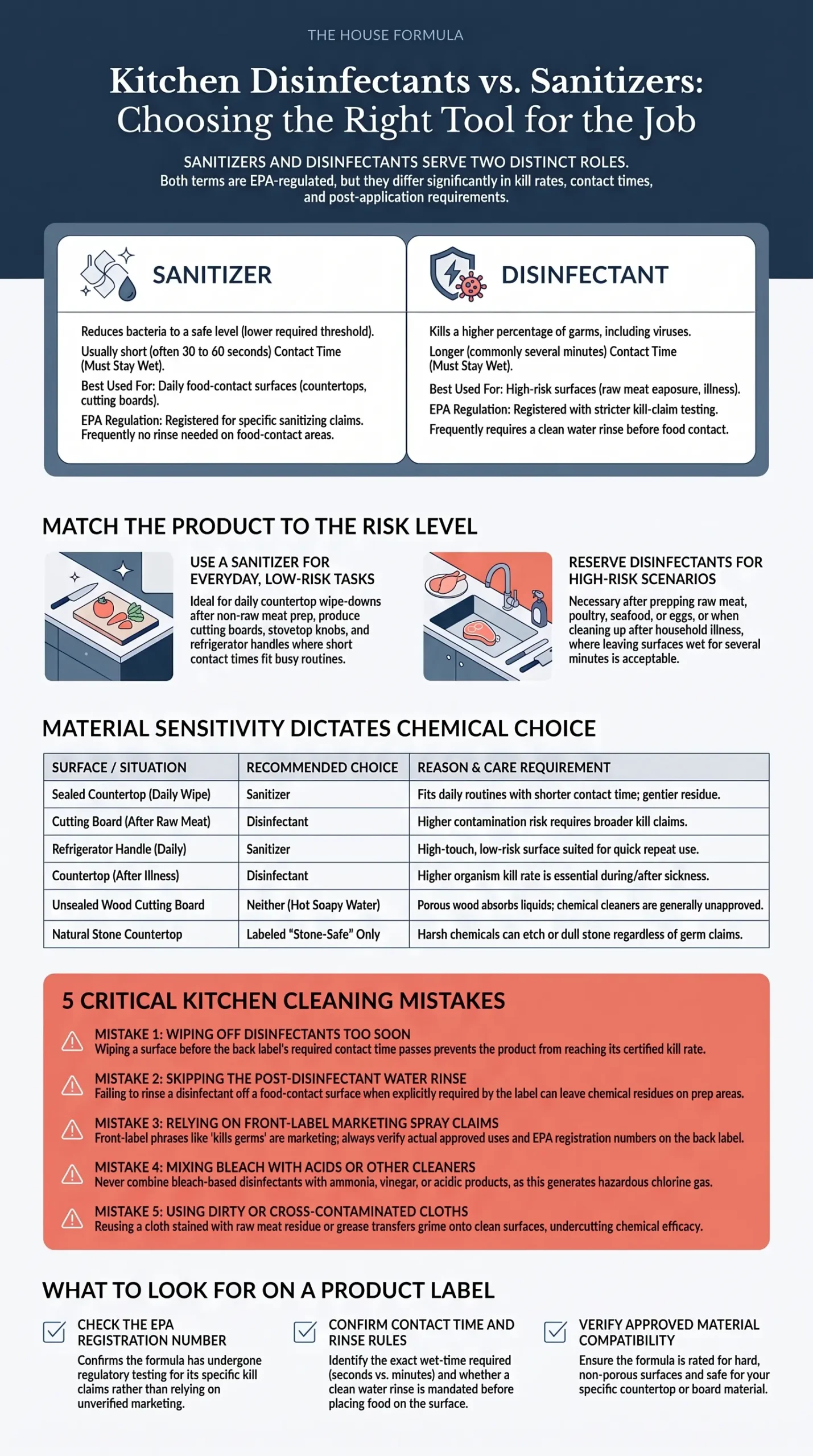
Photo Credit: Hobby Guidebook Editorial
When Is a Disinfectant Preferable in the Kitchen?
A disinfectant is the better choice for:
- Surfaces that touched raw meat, poultry, seafood, or raw eggs, where a broader kill claim genuinely matters more
- Cleaning during or after illness in the household, particularly surfaces touched by someone who was sick
- Cutting boards or countertops after handling something with a known higher contamination risk
- Situations where a longer contact time is acceptable, since the surface can be left undisturbed for the several minutes many disinfectants require
Because disinfectants are tested against a wider range of organisms and require more contact time, they're the more appropriate tool for higher-risk cleaning moments rather than routine daily wipe-downs. Using a disinfectant every single time you clean a countertop isn't necessarily more effective for general use and can also mean unnecessary chemical exposure or surface wear over time, particularly on softer countertop materials.
Whichever product you reach for, the cloth doing the actual wiping matters almost as much as the chemical itself. A cloth that's already carrying grease or old food residue can undercut even a properly applied disinfectant, since the product needs to reach the surface rather than get absorbed into leftover grime. Our guide on Microfiber vs. Cotton Cloths for Kitchen Cleaning breaks down which cloth type holds up better for this kind of repeated, product-heavy cleaning task.
Common Mistakes People Make With Disinfectants and Sanitizers
- Wiping off a disinfectant before the label's required contact time has passed. This is the single most common mistake, and it means the product hasn't had time to reach its labeled kill rate.
- Using a disinfectant on a food-contact surface without rinsing, when the label requires a rinse. Some disinfectant labels specifically require rinsing with clean water before the surface touches food again, and skipping this step can leave chemical residue on a surface where you're about to prep a meal.
- Assuming any spray labeled "kills germs" is automatically a disinfectant. Marketing language on the front of a bottle doesn't always match the EPA registration and specific claims on the back label, which is where the actual approved uses are listed.
- Combining a disinfectant with another cleaning product without checking compatibility. Never mix a bleach-based disinfectant with ammonia, vinegar, or other acidic cleaners, since this combination produces hazardous chlorine gas. Stick to one product at a time and rinse the surface with plain water before switching to a different product.
- Using the same cloth for sanitizing and for raw meat prep surfaces without washing it in between. This can spread contamination rather than remove it, regardless of which product was used.
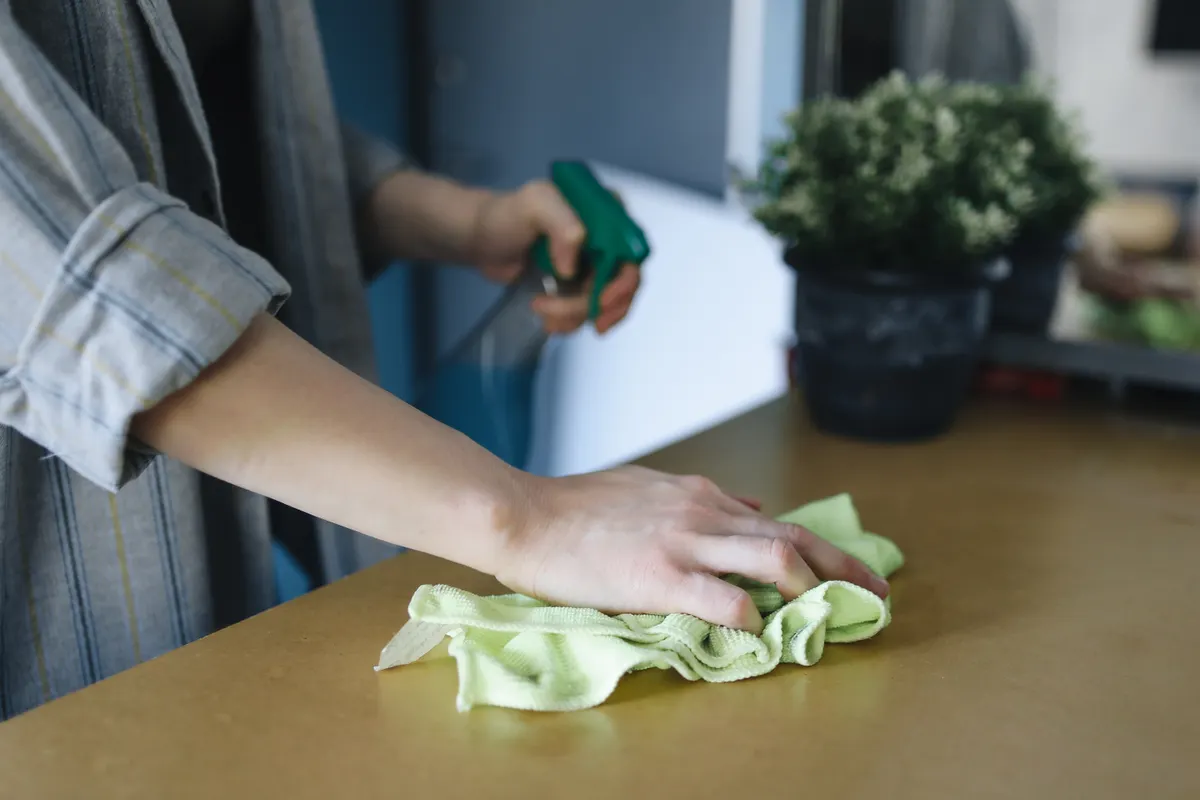
Photo Credit: Polina Tankilevitch
What to Look for on a Product Label
Choosing between products doesn't have to be complicated once you know what to check on the label:
- Look for the EPA registration number. This confirms the product has been tested and reviewed for its stated claims, rather than relying on marketing language alone.
- Check whether it's labeled as a sanitizer or disinfectant. The specific word used on the label reflects the actual tested kill claim, not just a general impression of strength.
- Note the required contact time. This is usually stated in seconds or minutes and tells you exactly how long the surface needs to stay wet.
- Check whether a rinse is required before food contact. Some products are labeled safe for food-contact surfaces without rinsing, while others explicitly require one.
- Confirm the surfaces it's approved for. Some formulas are meant for hard, non-porous surfaces only and aren't appropriate for wood, unsealed stone, or certain plastics.
There isn't one single "best" product for every kitchen, since the right choice depends on the surface, the task, and how much time you realistically have to let it sit. A quaternary ammonium-based spray works well for many hard countertop surfaces, while a diluted bleach solution is a common, cost-effective disinfecting option specifically for surfaces the label confirms are compatible with bleach.
Cost Considerations
Sanitizing sprays and wipes marketed for everyday kitchen use are generally inexpensive and widely available, making them practical for frequent use throughout the week. Dedicated disinfectant products can cost slightly more per use, particularly name-brand disinfecting sprays, though a diluted bleach solution mixed at home remains one of the more budget-friendly disinfecting options for surfaces confirmed compatible with bleach on the container label. Since disinfectants are meant for higher-risk situations rather than daily wiping, most households don't need to use them as often, which helps offset any difference in per-use cost.
Building the right habits around these products is easier with a stocked, organized supply setup rather than scrambling to find the right bottle mid-task. Our Essential Kitchen Cleaning Tool Checklist covers the full list of supplies worth keeping on hand, including where sanitizers and disinfectants fit alongside everything else in a well-equipped kitchen.
Photo Credit: Anna Shvets
Which Materials or Situations Call for Which Product
|
Surface or Situation |
Better Choice |
Why |
|
Sealed countertop, daily wipe-down |
Sanitizer |
Frequent use, shorter contact time fits routine |
|
Cutting board after raw meat |
Disinfectant |
Higher contamination risk needs broader kill claim |
|
Refrigerator handle, daily |
Sanitizer |
High-touch but low-risk surface |
|
Countertop after illness in household |
Disinfectant |
Broader kill claim matters more here |
|
Unsealed wood cutting board |
Neither, use hot soapy water and check manufacturer care guidance |
Porous surfaces absorb liquid differently, and many chemical products aren't approved for unsealed wood |
|
Natural stone countertop |
Sanitizer or disinfectant labeled stone-safe only |
Some chemicals etch or dull natural stone regardless of germ-killing claim |
Unsealed wood and natural stone deserve extra caution here, since a product's germ-killing claim doesn't guarantee it's safe for that specific material. When in doubt, check the product label for material compatibility, or lean toward hot soapy water and thorough drying for porous surfaces that aren't clearly rated for chemical sanitizers or disinfectants.
Building a Routine Around Both Products
Most kitchens do fine keeping both a sanitizer and a disinfectant on hand, reaching for the sanitizer during normal daily cleaning and the disinfectant specifically after raw meat prep or during illness. Having both readily accessible, along with the right cloths and a soft brush for textured surfaces, makes it easier to grab the right tool without improvising in the moment. The same principle, matching the product to the actual risk level rather than defaulting to the strongest option every time, applies just as much in other rooms of the house. Our comparison on Bathroom Disinfectants vs. Sanitizers Explained walks through how this plays out with bathroom-specific surfaces and higher-risk areas like the toilet.
A Quick Note on Safety
Always follow the specific contact time and rinse instructions printed on the product label, since these vary between brands and formulas. Never combine a bleach-based disinfectant with ammonia, vinegar, or other acidic products, as this can produce hazardous gas. Use these products in a well-ventilated area, and keep them out of reach of children and pets. If you're ever unsure whether a product is appropriate for a specific surface or situation, checking the manufacturer's label takes priority over general guidance, and a call to the product's customer support line can clarify anything the label doesn't cover.
FAQ
What is the difference between kitchen disinfectants and sanitizers? A sanitizer reduces germs to a level generally considered safe, usually with a shorter contact time. A disinfectant is tested to kill a broader range of germs and viruses at a higher rate, typically requiring a longer contact time to work as labeled.
When is a kitchen disinfectant preferable to a sanitizer? After handling raw meat, poultry, or eggs, during or after illness in the household, or any time a higher-risk contamination situation calls for a broader kill claim.
When is a sanitizer preferable to a kitchen disinfectant? For everyday countertop and high-touch surface cleaning that didn't involve raw protein, since the shorter contact time fits better into frequent daily use.
What are the main advantages and limitations of kitchen disinfectants and sanitizers? Sanitizers are quicker and gentler for frequent use but offer a lower kill rate. Disinfectants offer a broader kill claim but require longer contact time and sometimes a rinse before food contact.
Which materials or situations are suitable for kitchen disinfectants versus sanitizers? Sealed, hard, non-porous surfaces generally work with either, depending on the situation. Unsealed wood and natural stone need extra caution, since not every product is labeled safe for those materials regardless of its germ-killing claim.
For more tools and product guidance across the kitchen, view the full kitchen cleaning guide for additional routines and recommendations.


Leave a Reply